Three-Tier Client Server Architecture in Distributed System
The Three-Tier Client-Server Architecture divides systems into presentation, application, and data layers, enhancing scalability, maintainability, and efficiency. By separating concerns, this model optimizes resource management and allows for independent scaling and updates, making it a popular choice for complex distributed systems .

Three-Tier Client Server Architecture in Distributed System
Important Topics for Three-Tier Client Server Architecture in Distributed System
- What are Distributed Systems?
- What is Three-Tier Client Server Architecture in Distributed Systems?
- Importance of Three-Tier Client Server Architecture in Distributed Systems
- Components of Three-Tier Client Server Architecture in Distributed Systems
- Three-Tier Application In Web Development
- Benefits of Three-Tier Client-Server Architecture
- Disadvantages of Three-Tier Client Server Architecture
- FAQs On Three Tier Client Server Architecture
What are Distributed Systems?
Distributed systems are networks of independent computers that work together to achieve a common goal. They share resources and communicate over a network to provide services or perform tasks as if they were a single cohesive system. Examples include cloud computing platforms, online banking systems, and social media networks.
What is Three-Tier Client Server Architecture in Distributed Systems?
The Three-Tier Client-Server Architecture in distributed systems is a design model that separates applications into three distinct layers:
- Presentation Tier : The user interface layer, where interactions occur. It handles data display and user input.
- Application Tier : The business logic layer, which processes user requests, performs computations, and makes decisions. It acts as a mediator between the presentation and data tiers.
- Data Tier : The storage layer, is responsible for managing and storing data. It handles database operations and data retrieval.
This separation helps improve scalability, manageability, and flexibility by isolating each layer’s responsibilities.
Importance of Three-Tier Client Server Architecture in Distributed Systems
The Three-Tier Client-Server Architecture is crucial in distributed systems for several reasons:
- Scalability : Each tier can be scaled independently. For example, the application tier can be scaled to handle increased business logic load without affecting the presentation or data tiers.
- Maintainability : With a clear separation of concerns, developers can update or modify one tier without disrupting others, simplifying maintenance and reducing the risk of system-wide issues.
- Flexibility : Changes in one tier (e.g., updating the user interface) can be implemented without impacting the underlying business logic or data management, allowing for easier upgrades and customizations.
- Performance : Distributing tasks across different tiers can optimize resource use and performance. For instance, caching strategies can be implemented at the application tier to enhance response times.
- Security : Each tier can have distinct security measures. For example, sensitive data can be securely managed at the data tier, while the presentation tier focuses on user interaction.
Components of Three-Tier Client Server Architecture in Distributed Systems
The Three-Tier Client-Server Architecture is a layered approach to building distributed systems, with each tier serving distinct roles. Here’s a detailed explanation of each component:
1. Presentation Tier (Client Tier)
The Presentation Tier is responsible for the user interface and user interaction. It serves as the front-end of the application, where users input data and view results.
- Components:
- User Interface (UI): Includes web browsers, mobile apps, or desktop applications that users interact with. It displays data and collects user inputs.
- User Interaction Logic: Handles how user inputs are processed and communicated to the Application Tier. This can involve form validation, data formatting, and sending requests to the server.
- Display data from the Application Tier to the user.
- Collect user inputs and forward them to the Application Tier.
- Provide a user-friendly interface and manage user interactions.
2. Application Tier (Business Logic Tier)
The Application Tier is where the core business logic resides. It processes user requests, performs calculations, enforces business rules, and interacts with the Data Tier to retrieve or store data.
- Components:
- Business Logic: Implements the rules and processes specific to the application, such as order processing, authentication, or data validation.
- Application Server: Hosts the business logic and handles communication between the Presentation and Data Tiers. Examples include web servers or application servers like Apache Tomcat, Microsoft IIS, or JBoss.
- Process and interpret data received from the Presentation Tier.
- Execute business logic and apply rules.
- Communicate with the Data Tier to retrieve or store information.
- Send processed data back to the Presentation Tier for user display.
3. Data Tier (Database Tier)
The Data Tier is responsible for data management and storage. It handles all database operations, including data retrieval, updates, and management.
- Components:
- Database Management System (DBMS): Software like MySQL, Oracle, or Microsoft SQL Server that manages data storage and retrieval.
- Database: The actual repository where data is stored, organized in tables or other structures.
- Store and manage data securely and efficiently.
- Handle queries and transactions initiated by the Application Tier.
- Ensure data integrity, consistency, and availability.
- Provide backup and recovery mechanisms to protect data.
Interactions Among Tiers
- Client Request: The user interacts with the Presentation Tier, which sends a request to the Application Tier.
- Business Processing: The Application Tier processes the request using its business logic and may interact with the Data Tier to retrieve or update data.
- Data Retrieval/Update: The Data Tier handles data operations and sends the results back to the Application Tier.
- Response to Client: The Application Tier processes the results and sends the response back to the Presentation Tier for display to the user.
This tiered approach helps manage complexity by separating responsibilities, allowing for easier maintenance, scalability, and flexibility in distributed systems
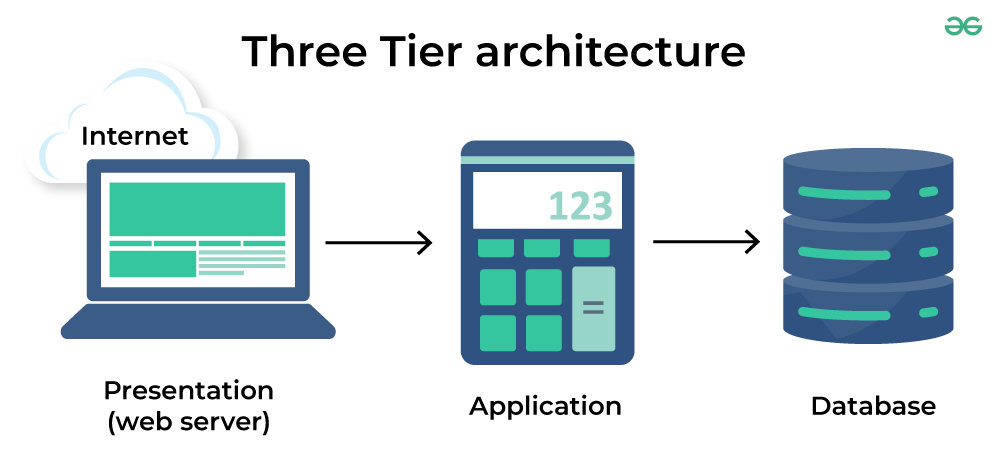
Three-Tier Application In Web Development
Web application will have the same tiers as the three architectures but only difference is that they are with different names.
- Web Server: Web server is an presentation tier of an three-tier architecture which servers as an presentation tier or UI (User Interface) tier. This content can be static or dynamic based on there requirement such as an e-commerce site where users can add products to their shopping cart, enter payment details, or create an account.
- Application Server: Application tier is an middle tier which consists the full logical that is required for the business which will process the user inputs and so on. It will performs the logic’s like queries the inventory database to return product availability or adds details to a customer’s profile.
- Database server: This is back-end tier of an web application it consists all the data so this tier mostly there will be data base such as MySQL, Oracle, DB2 or PostgreSQL.
Benefits of Three-Tier Client-Server Architecture
Below are the benefits of three-tier client-server architecture in distributed systems:
